To get comparable custom backpack quotations, give every supplier the same product brief, quantity breakdown and list of inclusions. Ask them to identify substitutions and unanswered questions separately. A low unit price means little if one quote includes your branding and packaging while another prices only an undecorated bag.
This guide is for brands, distributors and corporate buyers preparing a first request for quotation (RFQ). It includes a copyable brief and a comparison method. It does not assume a universal minimum order quantity, sample fee or production lead time.
Start here: Copy the RFQ template · Compare the replies · Define sample approval
1. Specify the version you want quoted
“A black laptop backpack with our logo” leaves several expensive decisions open. Identify a catalogue reference or attach a drawing, then separate what must stay from what may change. A supplier can then quote the requested version and offer an alternative without silently changing the specification.
- Intended user and load: describe the daily contents and whether the bag is for commuting, travel retail or a corporate programme.
- Size and fit: state external dimensions if known. For a laptop compartment, give the actual device and case dimensions; screen diagonal alone does not establish a fit.
- Construction: identify the opening, pockets, lining, back panel, straps and any removable parts that matter.
- Materials: provide an agreed fabric code or ask for options. “Oxford” and a D number are not a complete specification; see our backpack fabric comparison guide.
- Customisation: mark logo size and placement on an image. Request the proposed application method and a sample showing the final result.
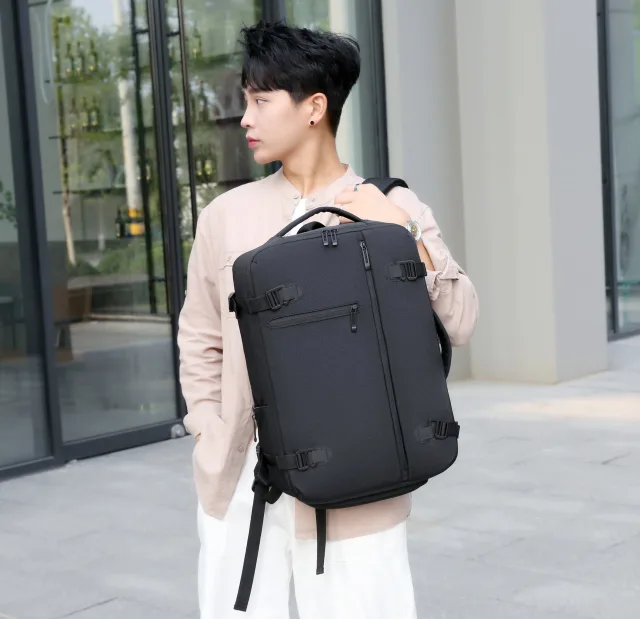
2. Copy this custom backpack RFQ template
Replace the bracketed prompts and leave genuine unknowns marked “please advise.” You can also download the plain-text RFQ template. It contains no customer information and needs no registration.
Subject: Custom backpack RFQ — [reference / intended use]
We are [company / sales channel], sourcing backpacks for [user and use] in [destination market]. Please quote the specification below and list alternatives separately.
- Reference link or drawing, including version/date: [ ]
- Required size, compartments and device fit: [ ]
- Fabric, lining and hardware: [specified codes / options requested]
- Estimated quantity per style and colour: [ ]
- Logo artwork, size, position and application: [ ]
- Labels, individual packaging and carton requirements: [ ]
- Sample needed and points to approve: [ ]
- Target delivery location and timing: [ ]
- Relevant market, retailer or test requirements: [ ]
Please state the minimum quantity for this exact specification; unit price and currency; one-off, sample and packaging charges; delivery basis and exclusions; quotation validity; payment proposal; and the steps that must be completed before the production schedule starts. Please flag every assumption or requested change.
3. Compare scope before comparing price
Put the replies side by side. Use “not stated” for an omission rather than treating it as included. The following is a buyer worksheet, not an estimate of YUEHU pricing.
| Compare | What to record | Question to resolve |
|---|---|---|
| Product basis | Drawing/version, fabric and component codes | Is this the requested bag or a lower-cost alternative? |
| Quantity basis | Pieces per style, colour and logo version | Does the price require a different colour split? |
| Included work | Logo, labels, packaging and inspection scope | Which items are charged separately? |
| One-off costs | Sampling, artwork setup and other quoted charges | Are any credits conditional on a later order? |
| Delivery scope | Named delivery point, transport and exclusions | Are both offers priced to the same place? |
| Schedule | Sampling, approval, production and dispatch stages | What starts the clock, and what remains unconfirmed? |
A practical comparison: if one supplier quotes a bag with a woven label and another quotes a printed logo, first ask for a common baseline. Keep any alternative as a separate option. You can then decide whether the change is worthwhile instead of mistaking it for a discount on the same product.
For a mixed order, ask for the minimum quantity and price for each version. Do not assume the total across several styles satisfies the minimum for every colour or custom component. If your volume is uncertain, request clearly labelled quantity scenarios, not a promise to order the largest one.
4. Define what the sample must prove
A stock reference sample can show a general shape; it cannot approve a logo or material it does not contain. Agree which details the next sample represents, label its revision and keep a written list of exceptions. For a foldable design, use the foldable backpack sample checklist alongside the quotation.
Record the agreed dimensions and tolerances, appearance reference, functional checks, packaging and who gives approval. The principle is consistent with ASQ's guidance on quality plans, which connects customer requirements with responsibilities, tests and acceptance criteria. The checklist here is an editorial planning aid, not a claim that a specific factory has passed an audit or test.
Do not release a version with unresolved critical requirements simply because a delivery date is approaching. Ask for an updated sample or a documented change before approving the specification for production.
Common first-order questions
Can I ask for a quote without a complete technical drawing?
Yes. Send a clear reference, intended use and must-have features, and ask which details are needed for a firm quotation. Treat the first response as provisional if material, size or branding choices remain open.
Should I ask only for the lowest MOQ?
Ask what the minimum applies to. An existing style with an available material may be a different proposal from a new pattern or custom-colour fabric. Compare the scope and total commitment, not just the smallest headline number.
How do I start a YUEHU enquiry?
Choose a catalogue reference or describe your own backpack idea, then send your sourcing brief to YUEHU. Include the quantity split and the decisions you need help with. Product specifications, sample arrangements, feasible customisations and commercial terms require project-specific confirmation.
Leave a Comment