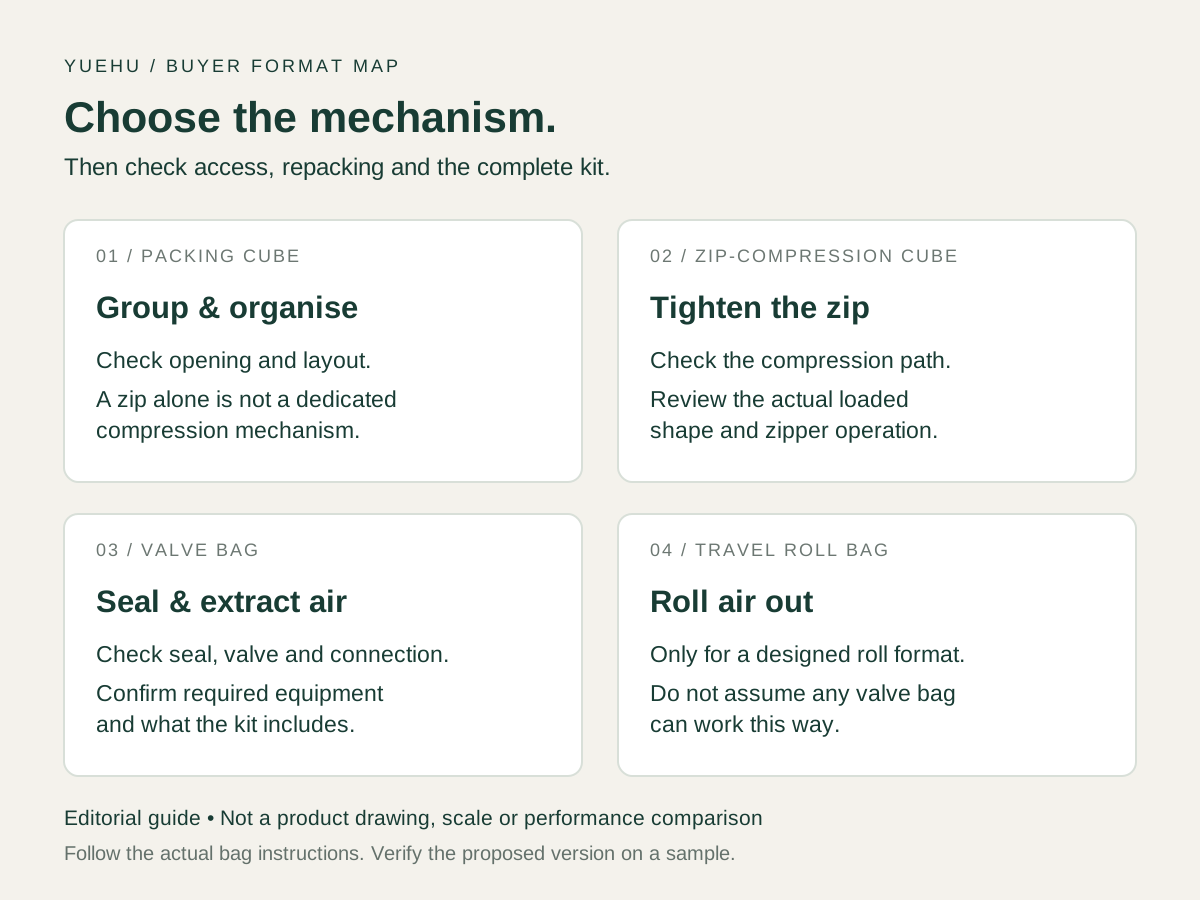
Compression packing cubes and vacuum bags solve related problems, but they are not interchangeable. A zip-compression cube reduces the depth of a fabric organiser mechanically; a valve bag needs its closure sealed and air removed through the intended outlet. Ordinary packing cubes mainly organise belongings. For a travel brand or retailer, the useful question is not simply “which saves more space?” but “which operation will our customer actually repeat during the trip?”
By YUEHU Buying Guides. Prepared and source-checked on October 17, 2026. This is a product-format and buying-decision guide, not a hands-on comparison or a performance test of YUEHU products. The sample checks below are proposed buyer exercises, not certified test methods.
The short answer: match the format to the trip
For a range built around sorting outfits and regular access, evaluate packing cubes first. If the brief also calls for a smaller packed depth without a separate air-extraction accessory, evaluate a zip-compression cube. If the customer is willing to seal and evacuate a bag, a valve-based vacuum format is another option. For travel without a vacuum or pump, a purpose-designed roll bag is a separate format to investigate—not a feature to assume of any vacuum bag.
That is a selection framework, not a ranking. The answer depends on the actual garment load, the finished bundle shape, the case it must fit and the customer's willingness to repack. A percentage taken from a different product's advertising does not settle those questions.
First separate the four mechanisms
1. Ordinary packing cubes: organise the load
A packing cube groups items inside a larger bag. The basic buying job is organisation: keep one person's clothes together, separate an outfit or move a group of items between bags. A zip closure alone does not establish a dedicated compression feature. Eagle Creek's organiser guide distinguishes cubes from compression sacs and describes using cubes to group clothing. Treat that as an example of the product categories, not evidence that every cube has the same construction.
2. Zip-compression cubes: tighten the organiser
Look for an actual compression arrangement, not just the word “compression” in a listing. For example, Eagle Creek's Reveal Compression Cube describes a compression zipper that compacts clothing. The operating idea differs from sealing a valve bag and drawing air out with a pump. Ask a supplier to show the proposed cube open, loaded, closed and compressed. Check how the zipper travels around the filled body and whether fabric catches in its path.
3. Valve-based vacuum bags: seal, then extract air
These require a working seal and the intended air-removal connection. Packmate's instructions distinguish traditional vacuum bags using a hose over a valve from its travel roll bags. That distinction matters when sourcing: a valve visible in a photograph does not establish compatibility with a customer's existing pump. Specify the bag, connection, accessories and instructions as one configuration.
4. Travel roll bags: a designed air-exit route
Some travel compression bags are designed to expel air by rolling. Eagle Creek's guide and Packmate's instructions describe this approach for their relevant products. Do not instruct a customer to roll an arbitrary valve bag, or assume “bag only” means “works without a pump”. Request the instructions and a demonstration for the exact reference. If the travel claim depends on rolling, this should be understandable from the retail pack, not discovered after purchase.
Compare access during the trip—not just the first packed photo
Imagine a customer who needs a shirt from the middle of a packed case. With a cube, the exercise is opening the organiser, taking the shirt and closing it again. With a vacuum format, restoring the previous packed condition also means re-establishing the seal and removing air by the intended method. A roll bag has its own re-rolling step. These are workflow differences; they are not measured claims that one format is universally quicker or easier.
Build a short use scenario into the brief: an overnight stay, several hotel changes or a return trip with extra clothing. Ask who will repack, what equipment will be available and whether the customer can reproduce the result using only the supplied instructions. If a pump is part of the proposal, include it in the travel kit and quotation rather than comparing a bare bag against a complete set. Our pump and packout guide covers that configuration decision separately.
Space, bundle shape and weight are different questions
Compressing the same clothes does not remove their mass. The organiser or bag—and any accessory carried with it—also belongs in the total packed weight. Do not turn a smaller-looking bundle into a promise of lower luggage weight or eligibility for a particular baggage allowance.
Compare the finished bundle in the actual case or backpack. A flatter package may still be too wide; a cube may leave space around its edges; several smaller organisers may fit a particular layout differently from one large bag. These are possibilities to check, not predetermined winners. Record the external dimensions of the filled bundle and confirm that the main bag closes normally without forcing it.
Material care is another separate decision. Packmate advises caution with items whose care or structure makes compression unsuitable. Check the clothing maker's instructions and the proposed bag's guidance rather than promising suitability for every fabric. This guide makes no universal wrinkle-free, waterproof, odour-proof or long-term protection claim.
A repeatable sample exercise for a travel range
Before requesting quotations, agree a garment list and a destination bag. Use the same clean, dry items for each candidate and record any item that cannot reasonably be packed. Keep model, revision and included components beside the observations so a later material or closure change does not inherit an earlier result.
- Pack and describe. Record the clothing list, folding arrangement and complete kit weight. Photograph the loaded sample with a ruler where dimensions matter. Do not compare empty dimensions with filled dimensions.
- Operate the mechanism. Follow the supplied instructions. Note zipper effort or snagging, the seal sequence, the pump connection or the roll method. Record questions instead of substituting an unapproved accessory.
- Fit the destination bag. Measure the finished bundle and put it into the agreed case or backpack. Record closure and access observations, including any items displaced elsewhere.
- Retrieve and repack. Remove one specified garment, then repeat the operation with only the accessories intended for the retail unit. Record any help the user needed.
- Review the next use. Agree an observation period suitable for the project and check the sample again. Record any change; one unchanged sample is not evidence of lifetime seal performance.
If you time an operation or calculate a volume difference, keep the raw measurements, load and method. Publish a number only with those conditions and a supportable scope. Our vacuum-bag sample comparison guide develops the seal and configuration review; this article helps choose which format merits that review.
Turn the decision into a sourcing brief
A useful first brief says: “Our customer is [type], travelling with [bag and load]. They need [organisation / a compression mechanism / a return-trip solution]. We want to evaluate [format] using [sample exercise]. Please identify the proposed version, included components and unresolved requirements.” Add target market, estimated quantity by version, branding and retail presentation. Ask suppliers to state exclusions and any configuration alternatives separately.
YUEHU's travel vacuum-storage reference page is a starting point for relevant bag enquiries, not proof of every mechanism described here. The comparison does not establish that YUEHU supplies zip-compression cubes or all roll-bag types; confirm feasibility before presenting a complete range to customers. A foldable spare travel bag may serve a different job—carrying extra items—not the same job as compressing clothes.
Common questions
Do compression packing cubes need a vacuum pump?
The zip-compression type discussed here uses its compression zipper rather than a vacuum pump. Confirm the actual construction; the shared word “compression” does not make all travel organisers operate alike.
Which format saves the most space?
This guide has not measured competing samples. Test the same load, destination bag and operating conditions before choosing or publishing a comparative claim. Also decide how much access and repacking convenience matters to the intended customer.
Can I sell a vacuum bag without a pump?
A bag-only quotation can be a valid scope, but it must clearly explain the equipment or method required. It is different from a demonstrated pump-free roll design. Confirm instructions, compatible equipment and what the customer receives before approving packaging.
Sources and editorial scope
Sources checked October 17, 2026: the linked Eagle Creek organiser guide and Reveal product page, and Packmate's operating guide. They support the mechanism distinctions, not YUEHU specifications, a head-to-head result or an endorsement. The selection framework and sample exercise are YUEHU Buying Guides' buyer-side recommendations. No supplier price, minimum quantity, certification or performance guarantee is established here. Send your sourcing question or a factual correction to YUEHU.
Leave a Comment