A convincing factory profile is a starting point, not a quality decision. When comparing Chinese backpack manufacturers, ask whether each supplier can demonstrate control of your backpack specification: the materials, sample, workmanship, changes and shipment you are actually buying.
This guide is for brands, distributors and sourcing teams shortlisting a supplier. It offers seven practical checks, not a ranking of factories or a claim that every manufacturer follows the same process. Keep a short evidence record so that attractive photos and low prices do not become your only basis for approval.
Updated 10 September 2026 by YUEHU Buying Guides. This revision replaces unsupported experience and industry-wide claims with a buyer evaluation checklist. Questions or corrections can be sent through our contact page.
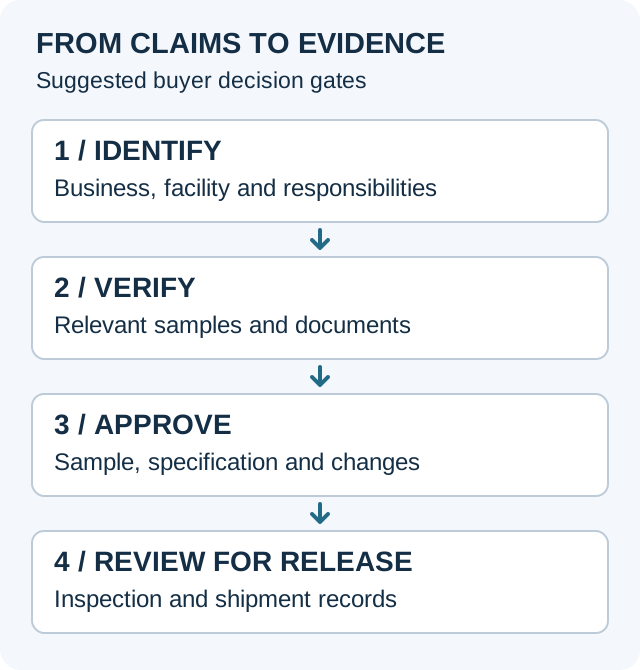
The seven checks at a glance
| Check | Ask to see | Resolve before approval |
|---|---|---|
| 1. Identity | Business identity and production location | Who makes the bag and owns each step? |
| 2. Relevant work | Comparable bag samples and construction details | Does the evidence match your bag type? |
| 3. Materials | Written material and component specifications | What exactly will be used? |
| 4. Sample approval | A versioned sample and acceptance criteria | What counts as acceptable? |
| 5. Inspection | Inspection scope and reporting plan | Who checks what, and when? |
| 6. Changes | A written change-approval process | Can substitutions happen without you? |
| 7. Shipment | Traceable packing and release records | What happens if a check fails? |
Download the supplier evidence checklist (TXT). It is a working record, not a certification or a substitute for a qualified inspection.
1. Establish who is responsible for production
Ask for the legal business name, production address and the relationship between the company quoting and the facility producing the bags. Confirm which steps are done in-house and which are subcontracted, including printing, embroidery or specialised finishing.
During a visit or a mutually agreed live video call, ask the supplier to explain the proposed production route for your design. A building photograph does not establish ownership, capacity or control of subcontracted work. Keep unresolved questions visible rather than treating missing evidence as either proof of quality or proof of wrongdoing.
2. Evaluate comparable work, not only a showroom
A structured laptop backpack and a lightweight foldable bag create different construction questions. Request samples close to your intended shape, openings, compartments and carrying arrangement. Look at the inside as well as the outside: seam finishing, lining access, strap attachments and hardware installation.
ASQ's supplier quality guidance includes specification-based quotations, supplier assessments and sample evaluation among ways to assess a potential supplier. Apply that principle to your own bag: record what was shown, what remains untested and which details differ from your planned product. For packable styles, use our foldable backpack sample checklist.
3. Turn material names into an agreed specification
Descriptions such as “premium fabric” or “heavy-duty zipper” are too open-ended for comparing offers. Ask for a material list covering the outer fabric, lining, reinforcement, padding, webbing, buckles, zippers and branding. Record the agreed colour reference and any approved alternatives.
For fabric, request the fibre, construction, weight where relevant, coating or backing and the evidence needed for any performance claim. A denier number alone does not define the complete material; our 210D, 420D and 600D guide explains the questions to ask. Do not assume that a report for one fabric also covers a changed coating or the assembled backpack.
4. Define sample approval in writing
Give the proposed approval sample a reference number and revision date. Link it to a specification covering dimensions, measurement method, agreed tolerances, artwork placement, opening direction and packaging. Photograph details that could otherwise be interpreted differently.
Separate appearance approval from functional evaluation. A neat seam is not a load-test result. For any required performance check, agree the method, conditions, acceptance criteria and who is qualified to perform it. Do not improvise safety tests or assume that one attractive sample proves the consistency of a production run.
5. Agree an inspection plan before production
Ask which materials will be checked on arrival, which construction stages need review and what the pre-shipment inspection will cover. Name the responsible party and agree when reports reach you. Include photos of defects and a process for communicating decisions, not just a final “pass” label.
If acceptance sampling is proposed, ask for the lot definition, sampling method, sample size, defect categories and acceptance or rejection criteria. ASQ explains that sampling plans specify sample sizes and decision criteria. Agree the appropriate plan with the responsible quality professional; a bare AQL number is not a complete inspection instruction or a guarantee that every item is defect-free.
If a supplier presents a certificate, check the named organisation, site, scope, issuer and validity. ISO's certification guidance describes verification through the issuing or accreditation body and relevant certification databases. A document must be relevant to the claim being made; do not treat a logo as evidence for every product feature. This article does not claim that YUEHU holds any particular certificate.
6. Control changes after the sample is approved
Ask what happens if a fabric colour, buckle, zipper or lining becomes unavailable. Require a written proposal showing the affected specification, cost, timing and whether another sample or test is needed. Confirm the change before it enters production.
Keep one current revision shared by the buyer and supplier. An inexpensive substitution can still change the appearance or feel your customer expects. When comparing quotations, include this approval process in the request; the backpack RFQ template helps organise the rest of the brief.
7. Decide what evidence releases the shipment
Before ordering, agree which records you need before shipment: quantities by style and colour, inspection findings, packing details and any project-specific documents. Link them to the purchase order and approved revision so they can be retrieved later.
Also agree the next step when results are unacceptable: containment, correction, reinspection and who authorises release. Commercial remedies and responsibilities belong in the agreed purchasing terms. A friendly conversation is useful, but it does not replace a documented decision.
Make a shortlist using evidence, not a universal score
Mark each check as verified, clarification needed or unresolved, with an evidence link and an owner. Do not let a strong price or a polished presentation cancel out an unresolved requirement essential to your product. The importance of each check depends on the bag, intended market and purchasing risk.
To discuss a YUEHU project, send a reference style or sketch, intended use, estimated quantity and the evidence you need to review. We can discuss the requirements without assuming that catalogue photos settle material, testing or commercial questions.
Discuss a backpack sourcing project or browse backpack and bag references.
Leave a Comment