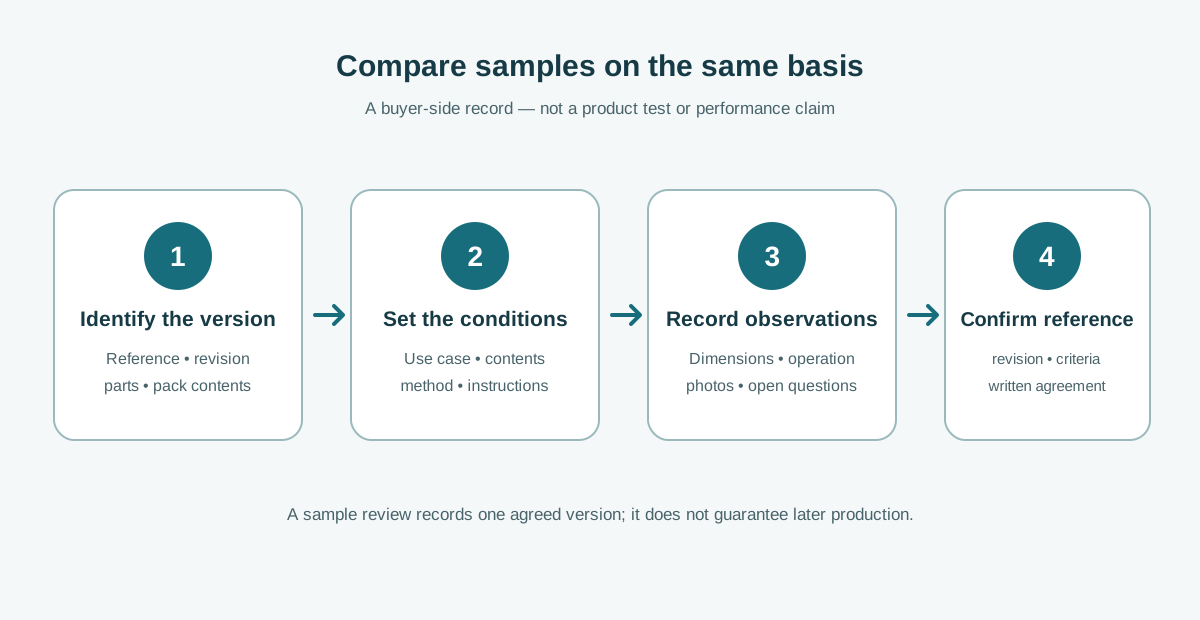
When two vacuum storage bag samples arrive, it is easy to compare what looks different and miss that they may not be the same configuration. A useful review starts by identifying each version, agreeing how it will be examined, and recording observations while the sample is in front of you.
This guide is for importers, retailers, distributors and private-label teams reviewing supplier samples before they approve a sourcing reference. It offers a repeatable buyer-side record—not a laboratory procedure, product test result, or claim about YUEHU products. Product construction, included parts and commercial terms must be confirmed for the specific project.
Prepared by YUEHU Buying Guides. No YUEHU vacuum storage bag samples were tested to produce this checklist; do not treat it as evidence of product performance or factory inspection.
Why sample comparisons need the same basis
A sample is useful only when the buyer can tell what it represents. Samples may differ in size, closure, valve, accessories, labels, packaging or revision. If one sample is reviewed with a pump and another without, or one is compared using a different preparation method, the notes will mix product differences with review-condition differences.
Use a simple check sheet to record observations as they happen. The American Society for Quality describes a check sheet as a structured form for collecting data and recommends defining what will be observed, when, and how before collecting it. That general data-recording idea can help a buyer keep sample notes comparable; it does not establish a vacuum-bag test method or a pass/fail threshold. See ASQ’s check-sheet guidance.
For a first quotation enquiry, the vacuum packing bag wholesale enquiry checklist helps organise the product reference, quantity, branding and open questions. This page addresses a later point in the process: how to record sample observations consistently after samples are available.
1. Identify exactly what each sample is
Give every received sample its own ID before comparing it. Record the supplier, date received, product reference, revision if stated, stated dimensions, material description supplied by the vendor, closure and valve reference, and every included item. Photograph the bag, labels and all accessories together so the review record can be traced back to what was actually received.
For vacuum storage bags, clarify whether the sample is a bag alone or a kit. Ask separately about any pump, adapter, instructions, labels and retail packaging. A product photo, catalogue title or supplier message may not identify everything that belongs in the quoted selling unit. Mark details as “not stated” when they are unknown; do not fill gaps by guessing.
If the supplier sends a revised sample, keep the old record and create a new sample ID. Record what changed and request confirmation of whether the revision affects the quotation, accessories or packaging. Do not overwrite the original sample notes.
2. Agree on the intended use and review conditions
Write down the use case that matters to the buyer—for example, packing garments in a suitcase or storing a defined set of household textiles. Name the representative contents or reference item, the preparation steps, and the method or accessory used. If the supplier provides instructions, record which version was followed and whether any step differed.
For side-by-side comparisons, use the same agreed contents, preparation, accessory type and observation sequence for each sample wherever practical. If the buyer cannot make the conditions identical, note the difference instead of treating the results as directly comparable. This makes the review more useful without suggesting that it is a formal performance test.
Before examining a feature that could become a marketing claim—such as air retention, compression, leak resistance or repeated-use life—agree a product-specific method and acceptance rule with the responsible buyer and supplier. Specify the sample identity, conditions, duration, number of samples, measurement method and what result would count as acceptable. A short visual review or one sample cannot substantiate a broad performance claim.
3. Record observations in four practical groups
Configuration and dimensions
Record the stated size and the buyer’s measurement, including how and where the measurement was taken. Keep the manufacturer’s stated specification separate from the buyer’s observation. Note any variation that needs clarification rather than deciding on the supplier’s behalf which number is authoritative.
Opening, closure and valve handling
Describe what you observed during the agreed opening and closing sequence. Note whether the closure was easy to identify, whether the valve or adapter matched the proposed method, and whether any step was unclear. Use neutral language such as “adapter not included in received sample” or “closure required a second pass,” not an unsupported diagnosis like “defective” unless it has been assessed against agreed criteria.
Included items and presentation
Count or list the parts present, inspect labels and instructions, and record the packaging version. If the buyer expects an accessory or printed insert, compare it with the written request. Do not assume that a sample kit’s contents will be included in a bulk quotation unless the quotation says so.
Time-based observations, if relevant
If the buyer and supplier agree to observe a sample over time, record exact observation times, room or handling conditions that matter, the initial state, and any change noticed. Do not invent a universal waiting period or acceptance limit. Report what was observed under those recorded conditions and keep interpretation separate from the raw notes.
4. Separate the observation from the decision
After recording what happened, list open questions, requested changes and the evidence still needed. A practical status for each item is “matches the written request,” “not assessed,” “clarification needed,” or “further evidence required.” These labels describe the buyer’s review state; they are not a product grade or certification.
When a sample is approved, record the exact sample ID and revision, approved artwork and packaging versions, the matching quotation or specification, and the inspection points that will apply to the order. Ask the supplier to confirm that the bulk-order reference is the same version. If a change is made later, keep a change record and review whether the sample approval still applies.
Sample approval is a decision about the sample and scope reviewed. It is not proof that every later unit will be identical, and it does not replace whatever production inspection, documentation or acceptance agreement the buyer requires. Define those separately before the order proceeds.
Downloadable comparison record
Use the vacuum storage bag sample comparison record (TXT) to keep one file per sample. It separates the supplier’s stated details from buyer observations and leaves room for open questions, photos and the approved version. For a formal test or inspection, agree a suitable method and criteria with qualified parties; this worksheet is not a substitute.
YUEHU’s travel vacuum packing bag reference and vacuum storage bag product reference can be used to identify a catalogue item for discussion. Their public pages do not establish that every sample includes the same parts or that a specific performance has been tested. Identify the exact reference and ask for current project-specific details.
Questions buyers often ask
Does a sample prove that a product will perform as expected?
Not by itself. A sample lets a buyer inspect the identified version under the conditions reviewed. Performance claims require defined requirements, suitable evaluation methods and evidence relevant to the product and intended use.
How many samples should a buyer review?
There is no universal number for every project. Decide with the responsible quality and sourcing teams based on the product, risk, order scope and evaluation method. Record how many samples were reviewed and do not imply that a single sample represents an entire production run.
What if two supplier samples look similar?
Compare the written details and included scope, not appearance alone. Ask each supplier to identify the version, material description, closure, valve, accessories and packaging included in its proposal. Keep any unconfirmed difference as an open question.
What information should be sent when requesting a project discussion?
Share the catalogue reference, intended use, target sizes, estimated quantities, desired accessories, branding and packaging status, and the questions you want the sample to answer. The vacuum storage bag project brief shows the current discussion route; availability, specifications and commercial terms remain subject to confirmation for each project.
Sources and boundaries
General recording principle: American Society for Quality, “Check Sheet”. This source supports using a structured form to capture repeated observations; it is not a vacuum storage bag standard.
This guide and its download provide a buyer-side discussion aid. They do not report YUEHU sample testing, inspection, certification or guaranteed manufacturing outcomes. Confirm product specifications, sample scope, accessory inclusion, quotation and acceptance requirements with the responsible parties for each project. To discuss a specific reference, use the YUEHU enquiry form.
Leave a Comment